One formation. Twenty-one mutations.
The
Formation
How a black-and-white firing line became a console laboratory, a rhythm game, a city projection and a climbing wall.
Begin at the cannon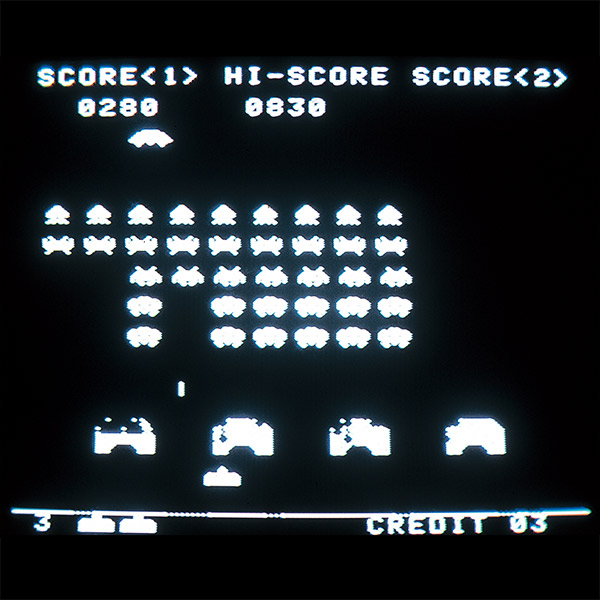
Arcade · Taito
Space Invaders
The formation became a system.
Tomohiro Nishikado’s original made a handful of parts feel alive: a marching block, one movable cannon, destructible shelters and a pulse that accelerates as the screen empties. The rising tempo was not decoration—it made the remaining enemies feel more dangerous.
Read the recordArcade · Taito
Space Invaders Part II
The formation learned to replenish itself.
Nishikado’s direct sequel made the grid less predictable: some invaders split when hit, reinforcements could refill the formation and a 500-point UFO rewarded precise timing. It also formalized the original rainbow display bug as a bonus and introduced high-score name entry.
Read the record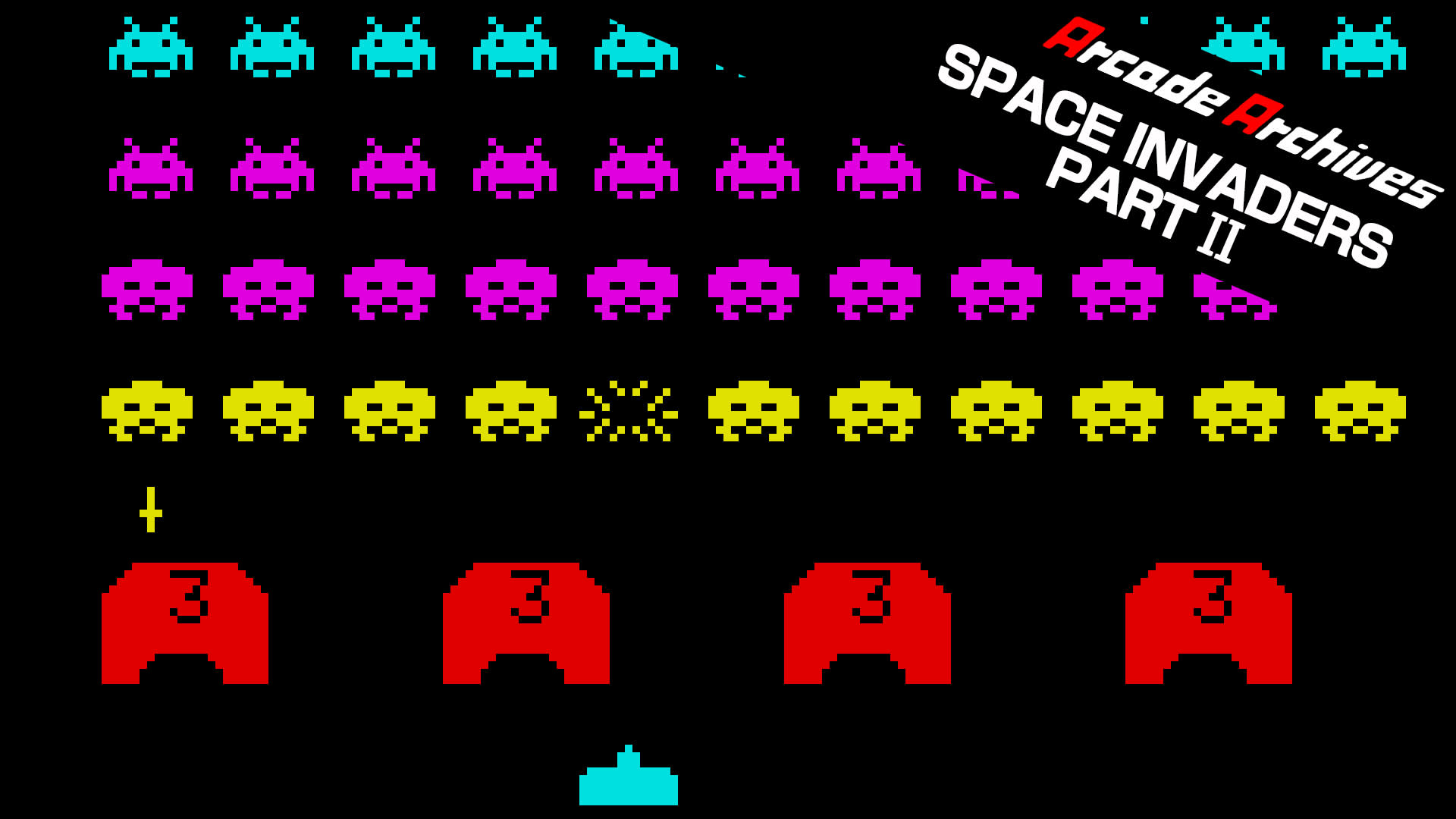
Atari VCS / 2600
Space Invaders
The arcade sensation became a cartridge laboratory.
Atari’s home version reshaped the field for the VCS and expanded one cabinet ruleset into 112 selectable variations. Moving shields, invisible invaders, two-player modes and other switches made replayability a feature—and helped turn the 2600 into a household machine.
Read the record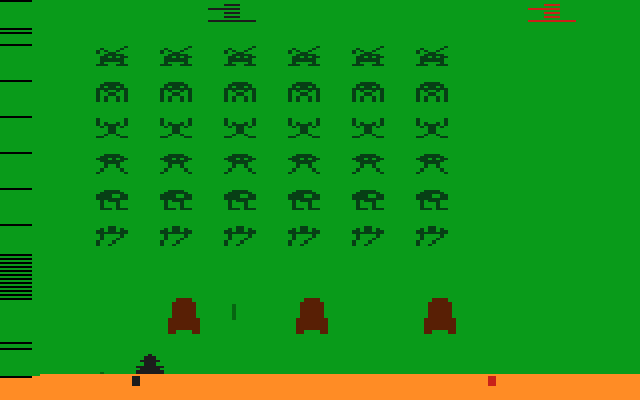
Arcade · Taito
Return of the Invaders
The invaders broke formation.
The true arcade sequel added vivid color and enemies that peel away from the grid to dive at the player. Weapon-bearing command aliens, changing formations and reflector enemies made aiming and timing more important than simply clearing rows.
Read the record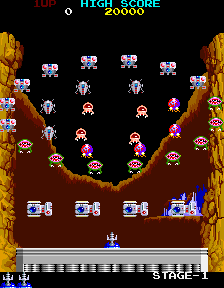
The Space Invaders Part IV · Arcade
Majestic Twelve
The sequel became a branching co-op spectacle.
Also released as Super Space Invaders ’91, Majestic Twelve added simultaneous two-player action, route choices, giant bosses and set-piece bonus rounds. Its flying-saucer cattle abduction turned the series’ stern minimalism into full arcade theater.
Read the record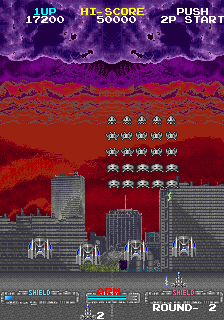
Arcade · Taito
Space Invaders DX
The series turned its history into selectable skins.
DX bundled the classic rules with display styles modeled on earlier releases, then added competitive versus play and a parody mode populated by characters from other Taito games. It treated arcade history as something players could remix.
Read the record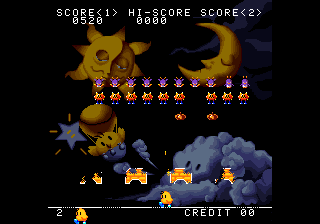
Attack of the Lunar Loonies · Arcade
Space Invaders ’95
The invasion became a character comedy.
Known in Japan as Akkanvader, this exuberant sequel traded military austerity for manga animation, expressive characters and absurd enemies. Charge shots and themed boss encounters gave each stage a punchline as well as a pattern.
Read the record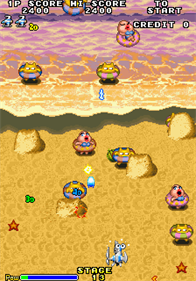
PlayStation / PC / N64
Space Invaders
Classic rows gained depth and weapon logic.
Z-Axis and Activision rebuilt the fixed shooter with polygonal worlds, dramatic bosses and a campaign that moves between planets. Destroying four matching aliens in sequence releases a corresponding power-up, turning target order into a tactical choice.
Read the record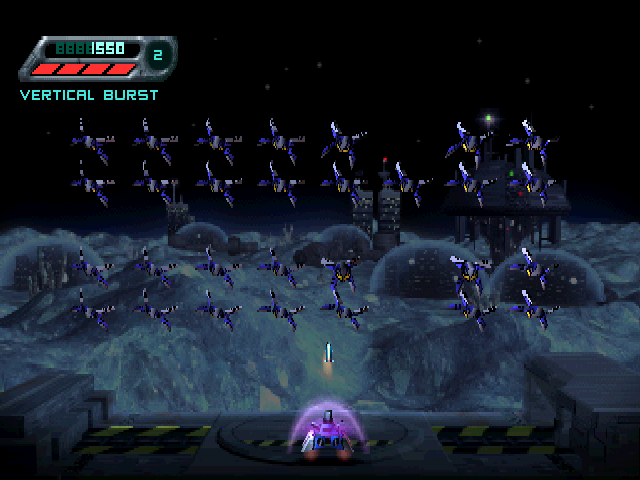
Space Invaders: Invasion Day · PS2 / GameCube
Space Raiders
The fixed shooter walked into the street.
Space Raiders moved the invasion into a ruined city and put human survivors on the ground. The formation remains legible overhead, but third-person movement, character stories and close-range danger turn the old abstract siege into a pulpy disaster movie.
Read the record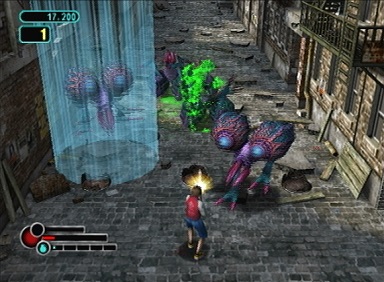
PlayStation 2 · Taito
Space Invaders Anniversary
A compilation became a playable museum.
Created for the 25th anniversary, this collection placed its variants inside Invader House, a navigable virtual arcade lined with cabinets, interviews and period material. Nine play stations ranged from black-and-white and color recreations to doubles, versus and a new 3D mode.
Read the record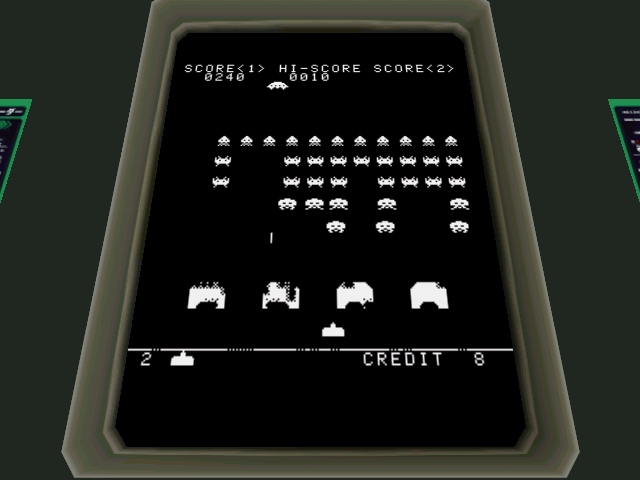
Nintendo DS · Space Invaders DS in Japan
Space Invaders Revolution
One formation became 60 rule-driven missions.
Alongside an arcade-faithful mode, New Era sent the invasion on a world tour through 20 locations and 60 challenges. Thirteen behavior-specific alien types and combinable power-ups turned each stage into a compact rules puzzle; the touchscreen was available without replacing button control.
Read the record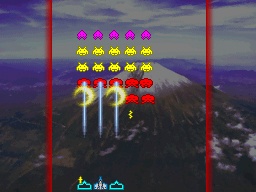
PSP · Japan
Space Invaders Pocket
The arcade lineage fit in a pocket.
This Japan-only portable archive collected four presentations of the original alongside Part II, Return of the Invaders, Majestic Twelve and Akkanvader. More than a single port, it made the branching arcade family playable together on one handheld.
Read the record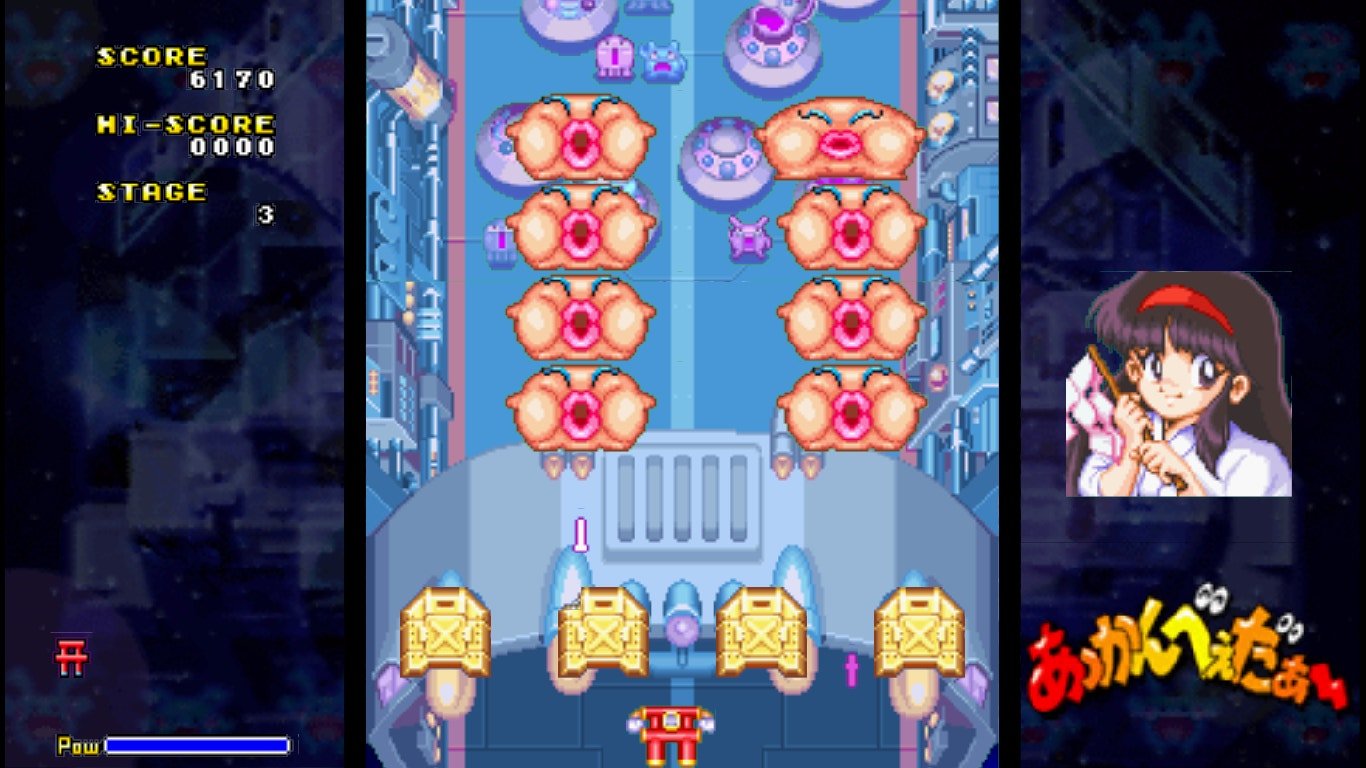
Mobile · Taito / Square Enix
3D Space Invaders
The fixed screen became a viewpoint.
Marketed internationally in 2006, this phone-sized experiment brought Anniversary’s 3D idea to mobile handsets. Polygonal invaders, switchable viewpoints and a first-person camera let players look through the familiar firing line. Its Japanese antecedent appeared as Cubic Invader in 2004.
Read the record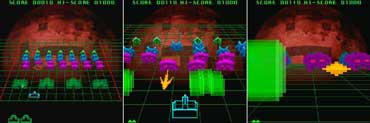
Nintendo DS / PSP
Space Invaders Extreme
Shooting became rhythmic score-chasing.
Extreme kept the recognizable formation but synchronized effects, shots and enemy behavior with an interactive electronic soundtrack. Color chains, combo routes, fever rounds and quick boss stages made every clean run feel like a live audiovisual performance.
Read the record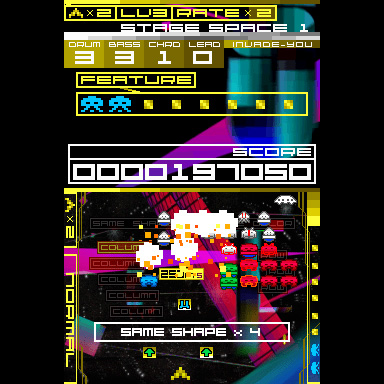
WiiWare
Space Invaders Get Even
You played the invaders.
Get Even flips the original fantasy: the player steers a UFO and directs a swarm across Earth. Pointing, circling targets and deploying different attack formations transforms a defensive fixed shooter into playful planetary demolition.
Read the record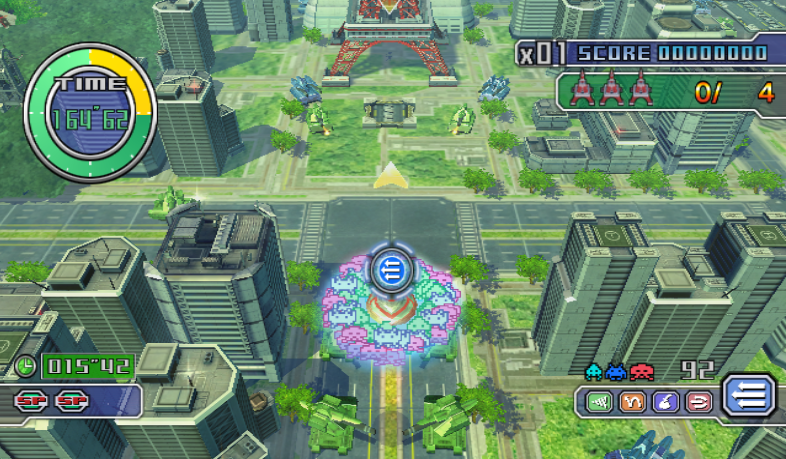
iOS · later PS3 / Xbox 360
Space Invaders Infinity Gene
The shooter evolved as you played.
Infinity Gene begins in near-monochrome simplicity, then unlocks weapons, movement and new systems through play. Its stark vector look and branching upgrade structure reinterpret evolution itself as the campaign’s central mechanic.
Read the record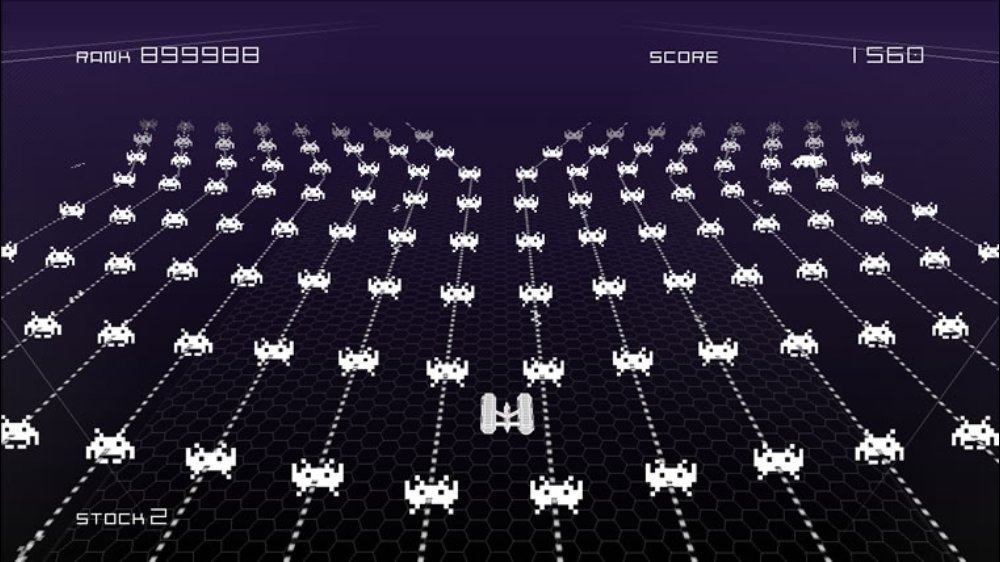
Arcade · Raw Thrills / Taito
Space Invaders Frenzy
The wall-sized cabinet became the spectacle.
Frenzy reimagined the firing line as a cooperative light-gun attraction. Two players face an eight-foot LED display made from more than 65,000 lights, trading the intimate monitor for a bright, physical crowd performance.
Read the record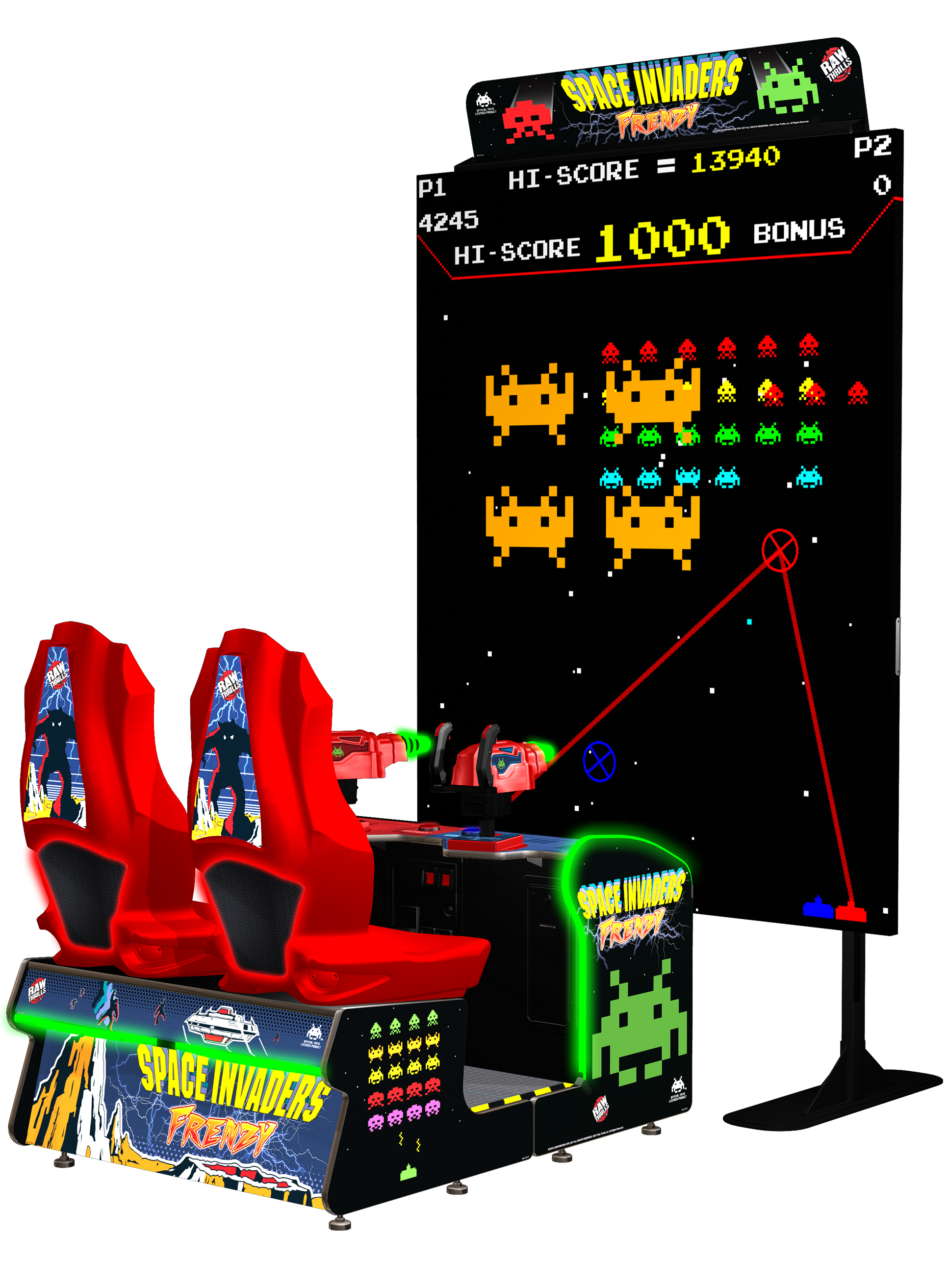
Play! Space Invaders · Tokyo
Space Invaders Gigamax
Ten players defended the Tokyo skyline.
For the game’s 40th anniversary, Gigamax projected an enormous shared formation across the windows of Tokyo City View. Ten stations let visitors fire together while the real city glowed behind the screen—arcade scale stretched into architecture.
Read the record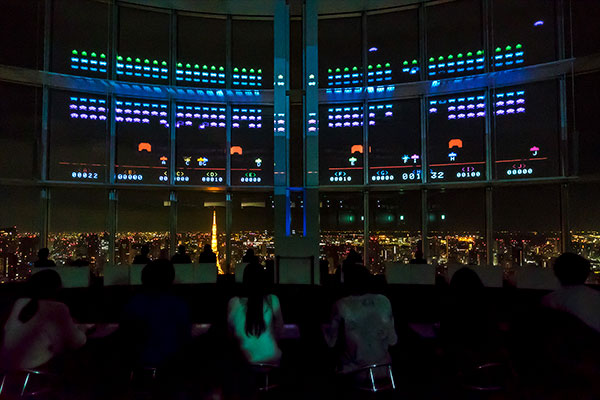
Play! Space Invaders · Tokyo
Arkinvaders
Players kicked the projectile across a virtual floor.
Arkinvaders crossed Space Invaders with Arkanoid on a room-scale floor projection. Instead of a joystick, players used their bodies to kick luminous balls at the formation while keeping those same projectiles in play.
Read the record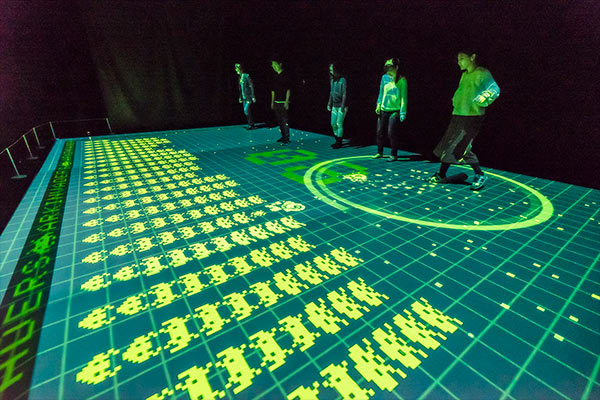
Play! Space Invaders · Tokyo
Noborinvaders
The climbing wall became the controller.
A projected invasion spread across a bouldering wall. Climbers had to reach toward aliens appearing around the holds, so route finding, balance and physical risk replaced the original cannon’s left-and-right movement.
Read the record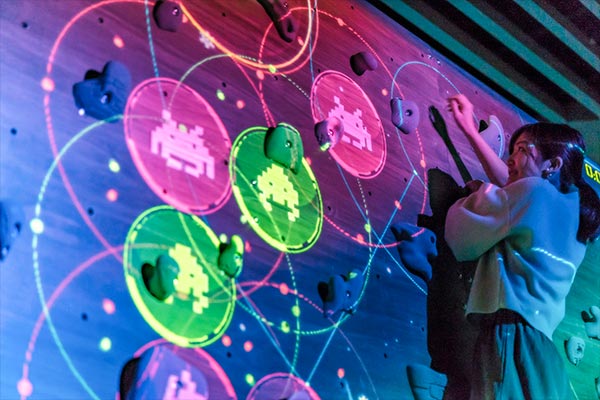
Play! Space Invaders · Tokyo
Bahamut Disco
The room—not a headset—became virtual reality.
Four players entered a floor-to-ceiling projection space, chose a color and swatted incoming invaders with tracked controllers. Pulsing music and imagery surrounded the group, turning the formation into a shared, headset-free dance battle.
Read the record
Forty years later
The grid never held still.
The durable idea was never just “shoot the aliens.” It was pressure made visible: a formation, a boundary and a shrinking amount of time. Every reinvention changed who moved, what counted as a controller, or how large the shared screen could become.
Source ledger
Trace the formation.
- 011978 · Space InvadersTaito · The Legacy ↗
- 021979 · Space Invaders Part IITaito · Series history ↗
- 031980 · Space InvadersAtari · Game manual ↗
- 041985 · Return of the InvadersTaito · Series history ↗
- 051990 · Majestic TwelveTaito · Series history ↗
- 061993/94 · Space Invaders DXTaito · Series history ↗
- 071995 · Space Invaders ’95Taito · Series history ↗
- 081999 · Space InvadersMobyGames · Release record ↗
- 092002 · Space RaidersLaunchBox · Release record ↗
- 102003 · Space Invaders AnniversaryTaito · Series history ↗
- 112005 · Space Invaders RevolutionNintendo · Japanese game archive ↗
- 122005 · Space Invaders PocketLaunchBox · Release record ↗
- 132006 · 3D Space InvadersSquare Enix · E3 2006 catalogue ↗
- 142008 · Space Invaders ExtremeTaito · Series history ↗
- 152008 · Space Invaders Get EvenTaito · Series history ↗
- 162009 · Space Invaders Infinity GeneTaito · Series history ↗
- 172017 · Space Invaders FrenzyRaw Thrills · Product archive ↗
- 182018 · Space Invaders GigamaxTokyo City View · Exhibition archive ↗
- 192018 · ArkinvadersTokyo City View · Exhibition archive ↗
- 202018 · NoborinvadersTokyo City View · Exhibition archive ↗
- 212018 · Bahamut DiscoTokyo City View · Exhibition archive ↗
Native-resolution pixel captures are enlarged without smoothing. Installation photographs come from official exhibition archives. Dates reflect original release years; Space Invaders DX is shown as 1993/94 because catalogues differ by market.